
Mini Bernedoodle vs Standard Size: A Complete Guide
Table of Contents
Mini Bernedoodle vs Standard Size: A Side-by-Side Comparison
Quick Comparison Table
Mini Bernedoodle Weight: What to Expect at Full Grown
Standard Bernedoodle Weight: Adult Ranges and Growth
Mini Bernedoodle Full Grown Size: Height and Body Type
How Bernedoodle Size Generations Affect Adult Size
Why size labels are not standardized
How to estimate an individual puppy's adult size
Questions to ask a breeder
Temperament, Exercise, and Grooming by Size
Which Size Fits Your Home and Lifestyle?
Conclusion: Choosing the Right Bernedoodle for You
Frequently Asked Questions
Last Updated: October 12, 2026
Mini Bernedoodle vs Standard Size: A Side-by-Side Comparison
Choosing between a mini Bernedoodle and a standard Bernedoodle comes down to one practical question: how much dog can you comfortably live with? A standard Bernedoodle typically stands 23 to 29 inches tall at the shoulder and weighs 70 to 90+ pounds, while a mini Bernedoodle usually lands between 18 and 22 inches and 25 to 35 pounds. That gap changes everything from car space to leash manners.
At JM Kennels, we have placed Bernedoodle puppies in family homes for over 30 years, and the size question comes up in nearly every conversation. It is also the question most buyers get wrong, because they compare puppy photos instead of adult numbers.
Below, we break down the mini Bernedoodle vs standard size difference using adult weight, height, and body type. You will also see how generation, parent size, and genetics shift those ranges.

Quick Comparison Table
Trait | Mini Bernedoodle | Standard Bernedoodle |
Adult weight | 25-49 pounds | 70-90 pounds |
Adult height | 18-22 inches | 23-29 inches |
Best for | Apartments, smaller homes | Houses with yard space |
Exercise needs | Moderate daily walks | Longer, more active sessions |
Grooming | Similar coat care | More coat, more brushing |
Lifespan | Often longer | Often shorter |
Mini Bernedoodle Weight: What to Expect at Full Grown
A full-grown mini Bernedoodle usually weighs between 25 and 35 pounds. Most land in this range, which keeps them manageable on a leash and easy to lift into a car.
Weight depends on several factors:
The size of the Miniature Poodle parent
The size of the Bernese Mountain Dog parent
The puppy's sex, since males often run larger
The generation, such as F1 or F1B
Individual genetics within the litter
A common mistake is assuming all minis stay small. Some minis from larger Poodle lines push past 50 pounds. Others stay closer to 25.
Pro Tip Ask the breeder for the weight of both parents, not just the mother. The father's size often predicts adult weight more accurately than the puppy's current weight.
Standard Bernedoodle Weight: Adult Ranges and Growth
A standard Bernedoodle typically weighs 70 to 90+ pounds as an adult. Males usually sit at the top of that range, while females run a bit lighter.
Growth follows a predictable pattern. Puppies gain quickly in the first six months, then slow down. Most standards reach close to their adult weight by 12 to 18 months. Full physical maturity, including muscle and bone density, can take up to two years.
What most guides miss is that standard Bernedoodles carry weight differently than minis. A standard has a heavier bone structure and a broader chest, so 80 pounds on a standard looks and feels different than 80 pounds on a leaner breed.
Mini Bernedoodle Full Grown Size: Height and Body Type
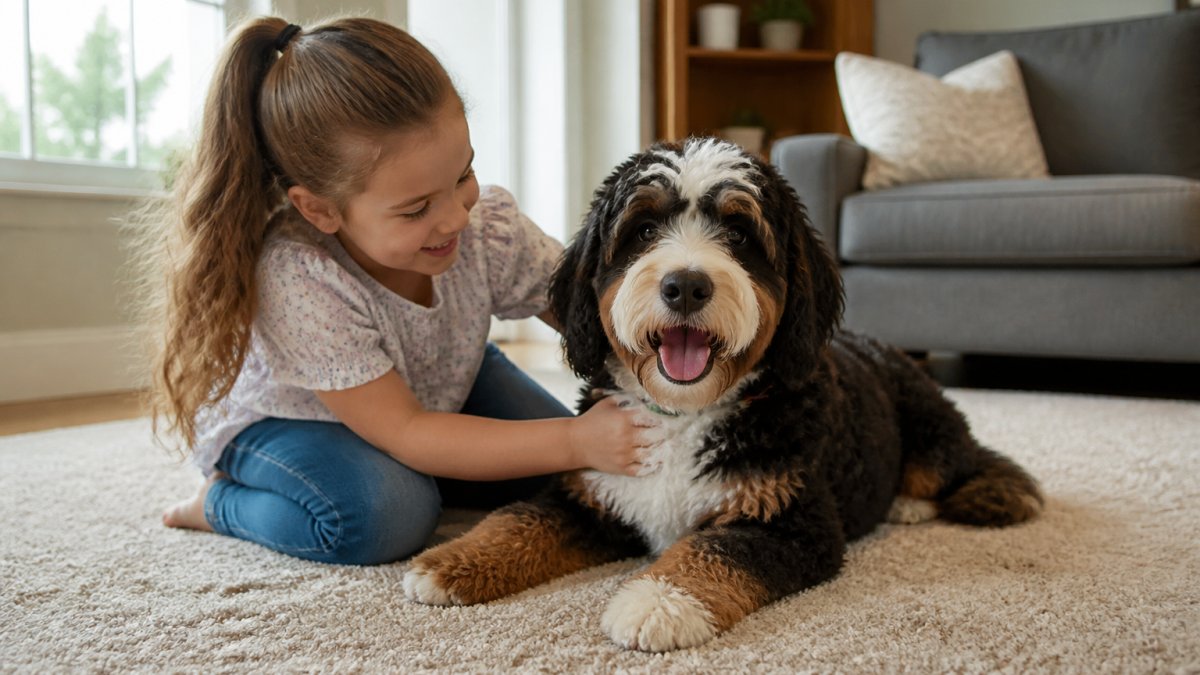
A full-grown mini Bernedoodle stands about 18 to 22 inches tall at the shoulder and weighs 25 to 35 pounds. A standard Bernedoodle stands about 23 to 29 inches and weighs 70 to 90+ pounds.
Height is the cleaner number to compare, because it is measured the same way for both sizes: from the ground to the highest point of the shoulder blades (the withers). Weight is messier, because two dogs of the same height can differ by 15 pounds depending on bone and coat.
Measure | Mini Bernedoodle | Standard Bernedoodle | Practical difference |
Height at withers | 18-22 in | 23-29 in | Mini's head sits near an adult's waist; standard's sits near the chest |
Adult weight | 25-35 lb | 70-90 lb | Standard can weigh 2-3x the mini |
Body build | Compact, moderate chest, straighter legs | Broader chest, heavier bone, deeper ribcage | Standard feels denser at the same height |
Typical adult size class | Medium | Large | Affects crate, seat, and door-gate sizing |
Body type matters as much as the numbers. Minis tend to carry a compact frame with a moderate chest and straight legs, which makes them agile and quick, a good fit for hiking, backyard play, and stairs.
Mini Bernedoodle full grown size also changes daily logistics in ways the numbers alone do not show:
Vehicle fit. A mini usually rides in a standard back seat or a small SUV cargo area without folding seats. A standard typically needs the seats folded or a large crate.
Crate sizing. Minis generally fit a 30- to 36-inch crate. Standards usually need a 42- to 48-inch crate.
Leash handling. A 35-pound mini can be managed by most adults one-handed. A 90-pound standard pulling on a leash is a two-hand job and a training priority.
Space at home. Minis can share a small apartment comfortably. Standards do better with a yard or a home where they can stretch out and turn without bumping furniture.
Food volume. Minis eat noticeably less per meal, which shows up in monthly food cost.
Key Takeaway If you only remember one comparison, remember this: the mini tops out around the height of a small Labrador, while the standard tops out near the height of a Bernese Mountain Dog. That single image predicts most of the space, cost, and handling differences between them. How Bernedoodle Size Generations Affect Adult Size Bernedoodle size generations describe how the dog was bred, and they influence adult size, but they are a weaker predictor than most buyers assume. The two most common labels are F1 and F1B. F1 Bernedoodle: A Bernese Mountain Dog crossed with a Poodle. Size varies widely because the two parents differ so much. F1B Bernedoodle: An F1 Bernedoodle bred back to a Poodle. The added Poodle influence often makes the dog smaller and the coat curlier. Multigenerational Bernedoodle: Two Bernedoodles bred together. Size becomes somewhat more predictable over time, but it does not lock in a number. The Poodle parent is the biggest single lever on size. A Miniature Poodle parent produces smaller puppies. A Standard Poodle parent produces larger ones. This is why two litters from the same kennel can vary so much, and why the generation label alone will not tell you how big your puppy will get. Why size labels are not standardized There is no single governing body that defines what "mini," "standard," "petite," or "micro" means for a Bernedoodle. Breeders and kennels use these words differently. One kennel's "mini" may top out at 30 pounds; another's may reach 50. A "petite" or "micro" label is even less consistent. Treat every label as a starting range, not a guarantee, and ask the breeder for the actual parent weights behind it. How to estimate an individual puppy's adult size Parent size and generation give you a range, not a prediction. To narrow it down, use these signals in order of reliability: Both parents' adult weights. The father's size is often the more useful number, because it is the one buyers forget to ask for. A mini with a 45-pound sire is likely to run larger than one with a 20-pound sire. The dam's and sire's height at the withers. Height tracks more consistently than weight across litters. The puppy's current weight and age. Puppies that are already at the top of their littermates' weight curve at 8 weeks tend to stay there. This is a trend, not a formula. The generation. F1B and multigenerational litters tend to be more predictable than F1 litters, because the Poodle influence is more consistent. Grandparent weights, if available. Useful when the breeder tracks lineage across generations. What none of these can do is guarantee a number. A tiny 8-week-old puppy can still grow into a 90-pound adult if the genetics behind it are large. That is why buying on puppy appearance alone is the most common mistake in this decision. Puppy Inquiry → Questions to ask a breeder What are the adult weights and heights of both parents? What size range do you expect from this specific litter, and why? How do you define "mini" and "standard" in your program? Can you share weights from previous litters with the same parents? Which generation is this puppy, and what does that mean for expected size? A breeder who can answer these with specific numbers is giving you a real estimate. A breeder who only says "he'll stay small" is giving you a guess. Generation labels and size words are marketing shorthand, not measurements. Always pair the label with the parents' actual adult weights before you commit to a size expectation. Bernese Mountain Dog breed standard and size information Temperament, Exercise, and Grooming by Size Temperament stays fairly consistent across sizes. Both minis and standards are friendly, intelligent, and affectionate. Both do well with children and make steady companions. Exercise needs differ. A standard Bernedoodle needs more daily activity, often an hour or more of walking, hiking, or play. A mini does well with 30 to 45 minutes, split into two sessions. Active households in the Rocky Mountain region often prefer standards for long trail days. Apartment dwellers usually do better with minis. Consistent movement remains essential for both sizes, though busy owners may find that professional dog walking services provide the necessary support to maintain these health requirements. Grooming is similar in method but different in volume. Both coat types, whether curly, wavy, or straight, need regular brushing. Standards simply have more coat to maintain, so plan on more frequent sessions. Factor Mini Bernedoodle Standard Bernedoodle Daily exercise 30-45 minutes 60+ minutes Brushing 2-3 times weekly 3-4 times weekly Professional grooming Every 6-8 weeks Every 6-8 weeks Best home type Apartment or small house House with yard Which Size Fits Your Home and Lifestyle? The right size depends on your space, schedule, and energy level. There is no universal winner. Choose a mini Bernedoodle if you: Live in an apartment or smaller home Want a lap dog that still joins short hikes Prefer easier handling on a leash Have children or older adults who walk the dog Choose a standard Bernedoodle if you: Have a yard and room to roam Want a dog for long hikes and camping Enjoy a larger, sturdier companion Can commit to more exercise and grooming Buying based on puppy size alone leads to surprises. A tiny puppy can grow into a 90-pound adult. Always ask for parent weights and expected adult ranges before you commit.
Conclusion: Choosing the Right Bernedoodle for You
The mini Bernedoodle vs standard size decision comes down to fit, not preference alone. Match the dog's adult weight and height to your living space, your daily routine, and your energy level.
JM Kennels raises both Mini Bernedoodle and standard Bernedoodle puppies in Johnstown, Colorado. Every puppy is microchipped, vaccinated, and dewormed, and each comes with our 72-hour, one-year, and two-year health guarantees. Our dogs undergo DNA testing, and we are licensed through PACFA.
Get started with JM Kennels and find the Bernedoodle size that fits your family.
Frequently Asked Questions
How big do mini Bernedoodles get compared with standard Bernedoodles?
Mini Bernedoodles typically reach 25-35 pounds and stand 18-22 inches tall at the shoulder. Standard Bernedoodles grow to 70-90+ pounds and 23-29 inches tall. The size difference comes from the parent breeds: minis are crossed with Miniature Poodles, while standards use Standard Poodles. Individual puppies can vary based on genetics and litter.
What is the average weight of a mini Bernedoodle?
Most mini Bernedoodles weigh between 25 and 35 pounds when fully grown. Weight depends on the size of the Poodle parent, the generation (F1, F1B, or multigenerational), and the individual puppy's genetics. A breeder can often estimate adult weight based on the parents' sizes.
How much does a standard Bernedoodle weigh?
Standard Bernedoodles usually weigh 70 to 90+ pounds as adults. Males tend to be heavier, often reaching the higher end of that range, while females typically weigh a bit less. Their height ranges from 23 to 29 inches at the shoulder. These dogs need more space, exercise, and food than mini Bernedoodles, which is an important consideration for families in smaller homes.
Are mini Bernedoodles easier to care for than standard Bernedoodles?
Mini Bernedoodles need less space, less food, and shorter walks, which can make them easier for apartment living or first-time owners. However, both sizes require regular grooming every 6-8 weeks, daily exercise, and training. Standard Bernedoodles need more room to run and can be harder to manage on a leash due to their size. The right choice depends on your living space and activity level.
Puppy Inquiry

Comments