
Are Bernedoodles Good for Families? What to Know
Table of Contents
Are Bernedoodles Good for Families? The Short Answer
Bernedoodle Temperament: What Makes Them Family-Friendly
Affectionate and Loyal Companions
Intelligent and Trainable
Bernedoodles Good with Kids: Safety and Compatibility
Age-Specific Considerations for Children
Supervision and Safe Interactions
Bernedoodle Exercise Needs: Keeping Up with Active Families
Daily Activity Requirements
Outdoor Adventures and Hiking
Bernedoodle Pros and Cons for Family Life
Key Advantages for Families
Realistic Challenges to Consider
Health, Lifespan, and Lifetime Care Demands
Lifespan by Size
Inherited Health Risks to Screen For
What Lifetime Care Actually Costs
The Family-Schedule Reality Check
Choosing a Responsible Breeder and Setting Your Family Up for Success
Frequently Asked Questions
Last Updated: October 19, 2026
Are Bernedoodles Good for Families? The Short Answer
Yes, Bernedoodles are excellent family dogs for the right household. These intelligent, affectionate companions combine the Bernese Mountain Dog's gentle nature with the Poodle's trainability. At JM Kennels, we've spent over 30 years breeding Bernedoodles for families seeking loyal, well-socialized companions.
The right fit depends on your lifestyle, your children's ages, and your willingness to meet their exercise and training needs. Temperament also varies between first-generation (F1) and second-generation (F2) dogs.
Bernedoodle Temperament: What Makes Them Family-Friendly
Bernedoodles are bred to be gentle, playful, and deeply attached to their people, combining the Bernese Mountain Dog's calm instincts with the Poodle's intelligence and eagerness to please, a dog that's patient with children and responsive to training.
Affectionate and Loyal Companions
A Bernedoodle's defining characteristic is its devotion to family members. These dogs bond with every person in the household and want to be where you are, whether that's on the couch or on the trail.
That loyalty means Bernedoodles struggle with isolation and can develop separation anxiety or destructive behaviors when left alone for long stretches. With someone home regularly or a midday dog walker, it's a tremendous asset; where everyone works long hours away, a Bernedoodle may not be the best choice.
Intelligent and Trainable
Intelligence matters enormously for family dogs: a smart dog is easier to train and less likely to develop behavioral problems. Bernedoodles inherit the Poodle's exceptional intelligence, ranking among the most trainable breeds.
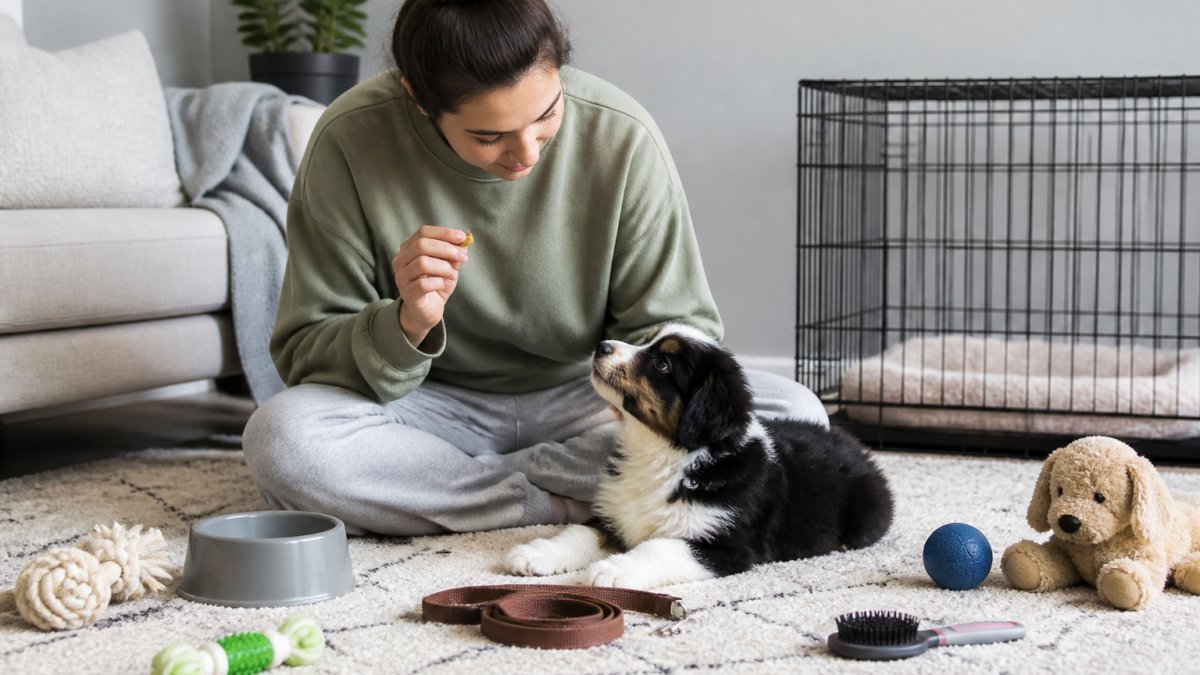
Bernedoodles respond well to positive reinforcement, pick up commands quickly, and seem to enjoy pleasing their owners. For first-time owners, that's a significant advantage, and early socialization and basic obedience yield visible results within weeks.
Bernedoodles Good with Kids: Safety and Compatibility
The question isn't whether Bernedoodles can be good with kids, it's whether your specific Bernedoodle, raised in your household, will be. Temperament is partly genetic but heavily shaped by socialization and training.

Age-Specific Considerations for Children
A Bernedoodle's compatibility with children depends significantly on your child's age and maturity level.
Infants and toddlers (0-3 years): A Bernedoodle can coexist safely with very young children but requires careful management. Even a well-intentioned puppy can knock over a toddler or nip during play.
Preschoolers (3-5 years): This age group benefits from a Bernedoodle's playfulness and patience, but young children may pull ears or corner a dog. A trained Bernedoodle tolerates this better than many breeds, but supervision remains essential.
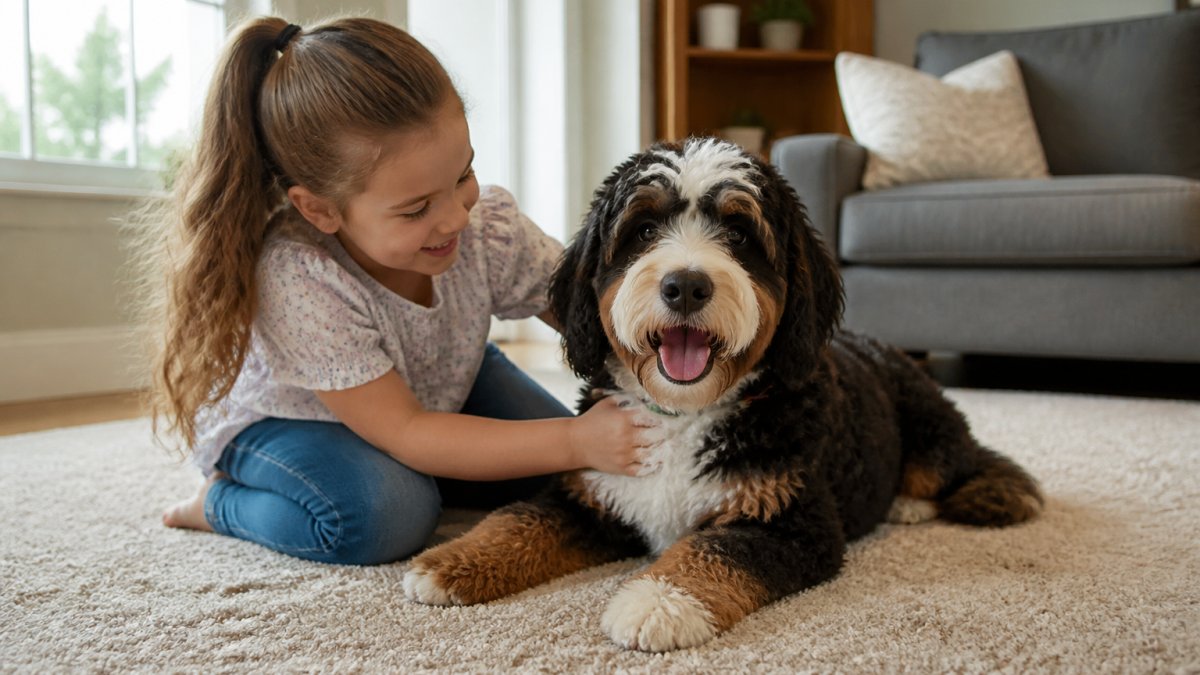
School-age children (6-12 years): This is where Bernedoodles truly shine.
Teenagers (13+): Bernedoodles make excellent companions for active teens, matching their outdoor energy and offering more nuanced interaction thanks to the breed's intelligence.
Supervision and Safe Interactions
Supervision isn't optional, it's the foundation of safe dog-child relationships, since even the gentlest Bernedoodle can react unpredictably if startled, cornered, or in pain.
Teach your children to recognize stress signals: a tucked tail, pinned-back ears, yawning, or lip licking often precedes a bite. Backing away and giving space when these appear prevents most dog-bite incidents in families.
For families with very young children, consider waiting until your youngest is at least 4-5 years old before bringing home a Bernedoodle puppy. Splitting focus between a demanding puppy and a toddler is genuinely difficult and increases the risk of accidents.
Bernedoodle Exercise Needs: Keeping Up with Active Families
Bernedoodles are not couch potatoes. They inherit the Bernese Mountain Dog's working heritage and the Poodle's athleticism, so families must be honest about meeting their exercise needs.
Daily Activity Requirements
A healthy adult Bernedoodle needs 60-90 minutes of exercise daily, meaning brisk walks, running, fetch, or play that elevates the heart rate, not a casual walk around the block. Without it, Bernedoodles become restless, destructive, and prone to behavioral problems.
For families with young children, this can feel overwhelming alongside kids' schedules and work. If your lifestyle is sedentary or you live in an apartment without nearby parks, a Bernedoodle may not fit. If you're genuinely active, the dog becomes an extension of that lifestyle rather than a burden.
Outdoor Adventures and Hiking
This is where Bernedoodles excel. Their size, athleticism, and love of their people make them ideal hiking companions who handle varied terrain and enjoy cooler weather thanks to their coat.
Many families find a Bernedoodle actually increases their outdoor activity: the dog becomes a motivator, and this feedback loop benefits both the dog and your family's health.
Bernedoodle Pros and Cons for Family Life
Most articles list Bernedoodle pros and cons in the abstract, which is useless when you're weighing one against school drop-offs, work schedules, and a grocery budget. Below is that breakdown against the real weekly workload your family will feel.
Key Advantages for Families
Highly trainable: The Poodle side is the main driver. Poodles were bred as working retrievers and are among the most biddable breeds, so a Bernedoodle usually responds well to marker-based positive reinforcement.
Gentle with children: The Bernese Mountain Dog contribution shows up as patience and a high tolerance for clumsy handling.
Low-shedding coat (generation-dependent): F1 and F1b Bernedoodles are most likely to have a low-shedding, allergy-friendlier coat, while F2 and multigenerational crosses can throw back to a heavier Bernese coat.
Active companions: Bernedoodles genuinely enjoy hiking, camping, and outdoor errands, and outdoorsy families often find the dog becomes a motivator rather than a chore.
Realistic Challenges to Consider
Exercise requirements are non-negotiable: Plan on 60-90 minutes of real activity per day for an adult, split into at least two sessions.
Separation anxiety is a real risk: These dogs are bred to be with people.
Grooming is a recurring line item: Bernedoodle coats mat easily, especially behind the ears, under the collar, and at the sanitary area.
Size and strength: Standard Bernedoodles commonly run 50-90 pounds. An untrained adolescent of that size can knock over a toddler or an older adult without meaning to.
Not a guard dog: Despite the size, Bernedoodles are typically friendly to strangers.
Teenage regression is normal: Many Bernedoodles go through a teenage phase around 6-18 months where recall and manners seem to disappear.
Key Takeaway Weigh the pros and cons against your actual week, not an idealized one. If you can cover two exercise sessions a day, a mid-day potty break, and a groomer every 6-8 weeks, the advantages of a Bernedoodle usually outweigh the challenges. If any of those three is a stretch, be honest about it before you bring a puppy home.
Health, Lifespan, and Lifetime Care Demands
A Bernedoodle is a 12-18 year financial and emotional commitment, and families deserve a realistic picture before falling in love with a puppy. The numbers below are ranges, not quotes, because costs vary by region, size, and generation.
Lifespan by Size
Standard Bernedoodles typically live 12-15 years. Mini and toy Bernedoodles often reach 15-18 years, though smaller dogs can be more prone to dental issues and patellar luxation. A puppy you bring home when your child is 6 may still be with you when that child leaves for college, plan for the whole arc, not just the puppy years.
Inherited Health Risks to Screen For
Bernedoodles inherit risks from both parent breeds. The most common ones families should ask about are:
Hip and elbow dysplasia: present in both Bernese Mountain Dogs and Poodles. Ask for Orthopedic Foundation for Animals (OFA) hip and elbow evaluations on both parents (Hip Dysplasia).
Eye conditions: progressive retinal atrophy and cataracts appear in both parent breeds. Ask for Canine Eye Registry Foundation (CERF) or equivalent eye clearances.
Von Willebrand disease: a bleeding disorder seen in Poodles. A DNA test on the parent dogs is standard.
Degenerative myelopathy: a neurological condition seen in Bernese Mountain Dogs. DNA testing is available.
Bloat (gastric dilatation-volvulus): a life-threatening emergency more common in deep-chested dogs. Families should know the signs and keep a plan for after-hours veterinary care.
A responsible breeder will have DNA and health clearances on both parents and will share them without pressure. If a breeder cannot produce OFA or equivalent clearances, treat that as a reason to walk away, not a detail to negotiate.
What Lifetime Care Actually Costs
Exact prices vary widely by region and by the size and coat of the dog, but the categories below are the ones families consistently underestimate. Budget for all of them, not just food and shots.
Routine veterinary care: annual exams, vaccinations, heartworm and flea/tick prevention, and dental cleanings. Dental cleanings alone often run several hundred dollars per visit and are frequently skipped, which is a mistake.
Grooming: professional grooming every 6-8 weeks for the life of the dog. This is one of the largest recurring costs of the breed and is easy to forget when comparing to a short-coated dog.
Training: at minimum a puppy class and a basic obedience class. Many families also budget for a private trainer during the teenage phase.
Preventive screening: hip and eye clearances are done on the parents, but owners should still plan for wellness bloodwork as the dog ages.
Emergency fund: a dedicated savings cushion is the single most useful financial step a family can take. Bloat, foreign-body ingestion, and cruciate injuries are the three emergencies Bernedoodle owners most commonly face, and each can run into the thousands.
Pet insurance or a self-funded equivalent: either route works, but pick one before the puppy comes home, not after the first emergency.
Watch Out Do not compare a Bernedoodle's cost to a short-coated breed without adding grooming. The groomer bill is the line item that most often surprises first-time Bernedoodle families, and it does not go away as the dog ages.
The Family-Schedule Reality Check
Health and cost are not abstract. A dog that needs a mid-day break, a groomer every 6-8 weeks, and a training class in the first year requires calendar space, not just money. Before committing, map the next 12 months of your family's schedule and confirm who covers each task. If the answer is "we'll figure it out," that is usually the family that ends up rehoming at 18 months.
Choosing a Responsible Breeder and Setting Your Family Up for Success
Not all Bernedoodles are created equal. Your family's experience depends heavily on the breeder you choose. A responsible breeder produces healthy, well-socialized puppies.
At JM Kennels, we've been licensed through the Pet Animal Care Facility Act since 2009. Our breeding dogs undergo extensive DNA testing, and every puppy is microchipped, vaccinated, and dewormed before going home.
When evaluating breeders, ask about their health guarantees specifically. What conditions are covered? For how long? If your dog develops hip dysplasia at age 3, will they truly stand behind that guarantee?
Are Bernedoodles good for families? Yes, for families willing to meet their exercise needs, provide consistent training and socialization, and commit to 12-18 years of companionship.
Frequently Asked Questions
Are Bernedoodles calm or hyper?
Bernedoodles typically balance playfulness with calmness, though individual dogs vary. They inherit the Bernese Mountain Dog's gentle, laid-back nature alongside the Poodle's intelligence and energy. Most Bernedoodles settle into a calm demeanor indoors after adequate daily exercise, making them suitable for families who can provide 30-60 minutes of activity daily. Proper socialization and training reinforce calm behavior at home.
Are Bernedoodles good with kids?
Yes, Bernedoodles are generally excellent with children due to their affectionate, patient temperament and loyalty. They are gentle and enjoy companionship, making them reliable family pets. However, success depends on early socialization, proper supervision with young children, and teaching kids how to interact respectfully with the dog. Responsible breeders produce well-socialized puppies, which significantly improves their compatibility with families.
Do Bernedoodles need a lot of exercise?
Bernedoodles require moderate to high exercise, typically 30-60 minutes daily depending on the generation and individual dog. They thrive with active families who enjoy hiking, outdoor play, and mental stimulation. Without adequate exercise, they may develop behavioral issues or anxiety. Families considering a Bernedoodle should be prepared for consistent daily activity and mental enrichment to keep them happy and well-adjusted.
What's the difference between F1 and F2 generation Bernedoodles?
F1 Bernedoodles are first-generation crosses (50% Bernese Mountain Dog, 50% Poodle), while F2 are second-generation (two F1 parents). F1 dogs tend to have more predictable traits and often better hypoallergenic coats. F2 Bernedoodles show more genetic variation, meaning temperament, size, and coat type can be less consistent. Both can be excellent family dogs, but F1 puppies from reputable breeders with health testing offer more predictability for families seeking specific traits.
Puppy Inquiry

Comments